
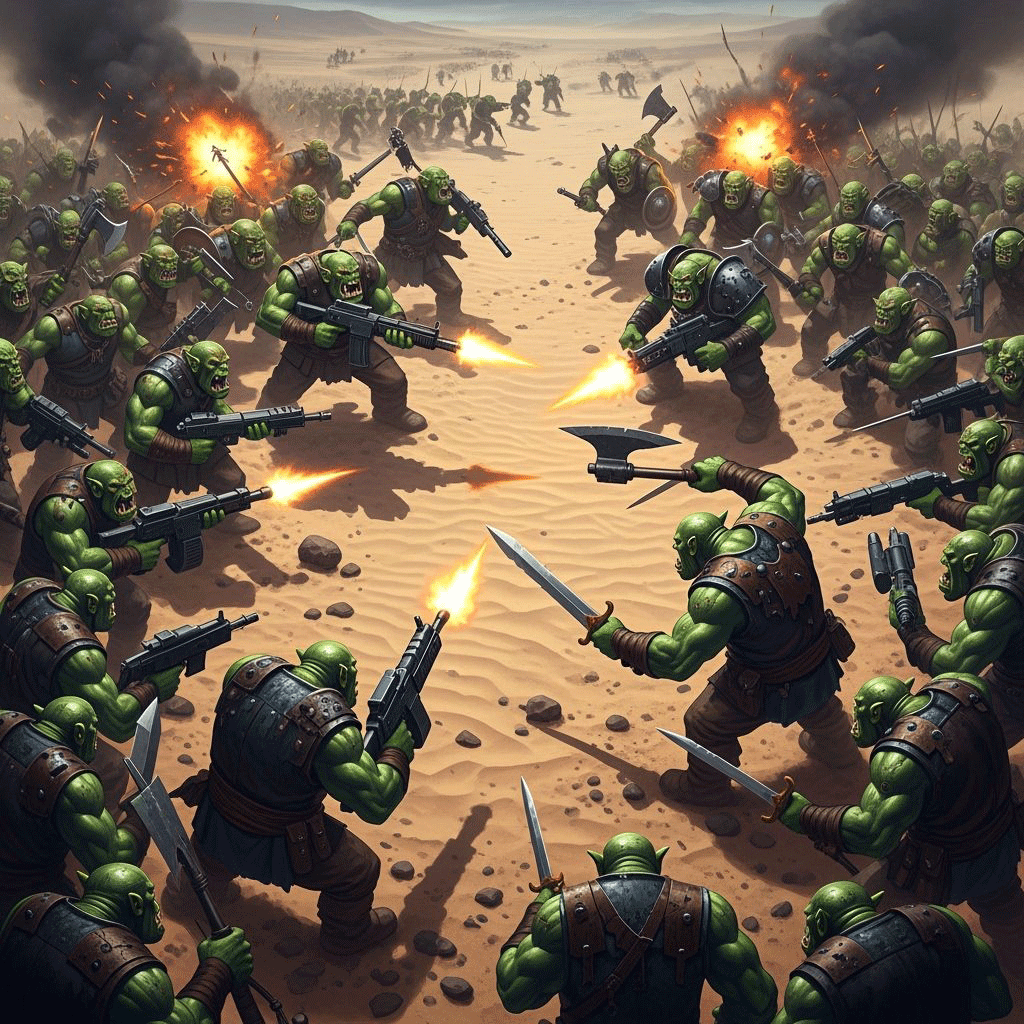
The Imperium’s tenuous control of Susa City on the mining moon of Hegira has only been possible because the greenskin invaders are fighting amongst themselves for control of the ork invasion. (Click on image for larger picture.)
“War Zones” is a semi-regular feature of the Corvus Cluster, designed to update readers about ongoing military campaigns in our little corner of the galaxy.
It’s a useful feature, as there are only so many tabletop battles that can be fought in a year, and some ongoing campaigns simply aren’t getting enough attention.
This “War Zones” will be a little different. Instead of a detailed update of a single planetary campaign, this article will provide a look at several key battles that have been fought across our war-torn region.
I think it’s a good way to “advance the narrative” of our overall campaign.—TheGM
* * *
Although Kaptin’ Rumlar Grimrekkah has led the ork invasion of Hegira for more than a decade, there has never been a confirmed sighting of this xeno warlord.
Rumlar defeats rival on Hegira
HEGIRA—The warlord Rumlar Grimrekkah, who nearly conquered Hegira some years ago, apparently has defeated a major threat to his authority over the greenskin menace that continues to threaten Imperial authority on the mining moon.
Nearly 1 million orks recently engaged in a 27-day battle on the outskirts of the greenskin-held Barad Mine, to the west of the moon’s beleaguered capital of Susa City.
A rising warlord named “Baddruck Bonebreaker” had gathered a host of 440,000 orks and marched to the site of a Warp phenomenon to the southeast of the Barad Mine. There, “Kaptin’ Rumlar” has spent recent years studying the strange lights of the phenomenon—so much so that he has largely abandoned his control over the ork horde on the moon.
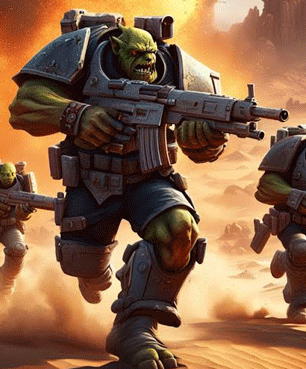
Imperial intelligence officers have never been able to accurately estimate the number of orks on Hegira, but it clearly is in the tens of millions.
To Imperial strategists, Rumlar’s laxity of oversight has been a blessing. The momentum of what appeared to be a burgeoning ork Waaagh! was lost by his absence and, instead of driving Imperial troops from the moon, the greenskins began fighting amongst themselves. Given a years-long respite, Imperial troops have heavily fortified those parts of the planet they still hold.
Apparently Baddruck decided it was time to reunite the squabbling orks horde and finish off the “humies,” but when he attempted to overthrow Rumlar, the mighty ork warlord shook off his malaise and gathered 600,000 still-loyal orks and met Baddruck’s attack head-on.
As senior Imperial military leaders observed from orbital surveillance satellites, the two ork armies met on an open field in a brutal clash without tactics.
The battle began on 3 054 476.M41 with the two hordes simply charging into each other and beginning a senseless slaughter. One group of Speed Freaks attempted a flank attack on Rumlar’s forces but soon found themselves swamped by the superior number of loyalist greenskins.
On the 26th day of fighting, Rumlar finally confronted Baddruck in a one-to-one duel. As thousands of orks stopped fighting to watch this epic clash, the two warlords battled for six hours before Rumar finally managed to bring his power mace down on his rival’s skull and crush it beyond hope of survival.
With Baddruck’s defeat, a major threat to Rumlar’s rule has ended, and Imperial military authorities are nervous: Will Rumlar return to his study of the Warp phenomenon that has been his obsession for years? Or will this dangerous warlord shake off his lethargy for war and retake the helm of the vast ork forces on the planet.]
* * *
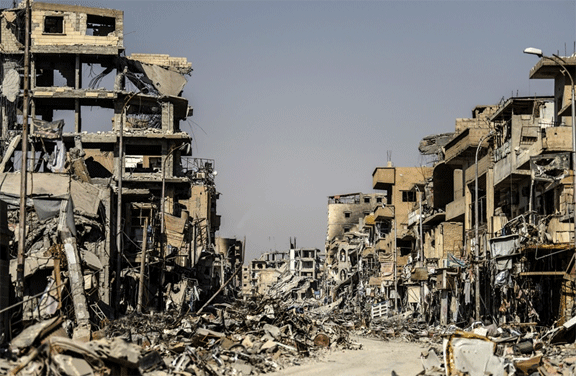
The ruins of the city of Miletus have been abandoned for years—but the ruins recently were the scene of a small but significant Imperial victory.
Victory at the Miletus Ruins
ICONIA—The city of Miletus was destroyed in 742.M41 by ork invaders who swept through the Akash Desert on a rampage of destruction that eventually led the greenskins to the equatorial jungles the following year.
Although uninhabitable, military authorities realized the ruins still contained significant quantities of plasteel, ceramics, and other resources that the xenos might one day wish to salvage for their haphazard war production.
That proved the case in early 746.M41, when a sizable force of orks appeared at the edge of the Akash Desert and began marching toward Miletus.
This was an opportunity the Iconian high command was eager to exploit. During the greenskins’ march across the open desert, Valkyrie gunships began a week-long strafing of the 50,000-strong ork warband. Nine Planetary Defense Force (PDF) regiments rushed to Miletus and began building hasty emplacements, and mechanized artillery advanced into the desert, opened fire on the orks at long range, and steadily withdrew and continued firing as the orks followed.
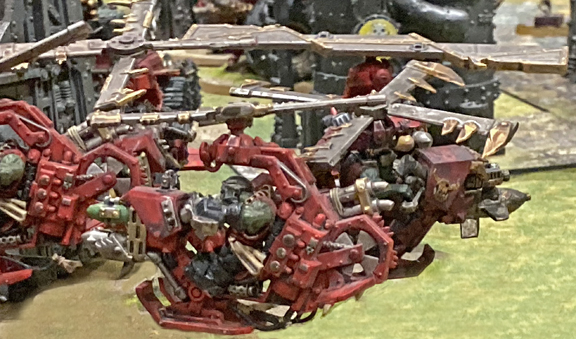
Although not directly involved in the battle for Miletus, an ork aerial warband–known as “Gutkrumpa’s Kill Koptas”—managed to strike repeatedly at Imperial supply lines. It’s not clear whether this was a coordinated effort to help the orks seize Miletus or simply an opportunistic raiding campaign.
When the orks finally reached the city ruins on 6 089 746.M41, the withdrawing Imperial artillery had returned to the safety of the Imperial defenses, and the orks came under extensive fire as heavy weapons teams joined by the now stationary Basilisk, Medusa, and Wyvern batteries.
Enraged by the humans hiding behind entrenchments, and thrilled by the battle they found themselves in, the greenskins mindlessly charged the Imperial position.
Ork casualties were immense, yet about 20 percent of the ork warband—about 10,000 strong—managed to storm the Imperial lines. There, the orks were met with flamer teams that proved spectacularly effective in stemming the greenskin momentum.
Still, thousands of orks managed to penetrate the Imperial emplacements, and PDF troops were forced to engage in close combat—firing at point-blank range as well as engaging in hand-to-hand combat with the muscular and towering xenos. Reports suggest that it took three to five soldiers to bring down a single ork, and these fights usually resulted in two to three human casualties for every ork killed.
In the end, the PDF won the day. It’s estimated that at least 80 percent of the ork force was killed, with only a few thousands greenskins successfully retreating. PDF casualties were approximately 40 percent—or 20,000 men.
* * *
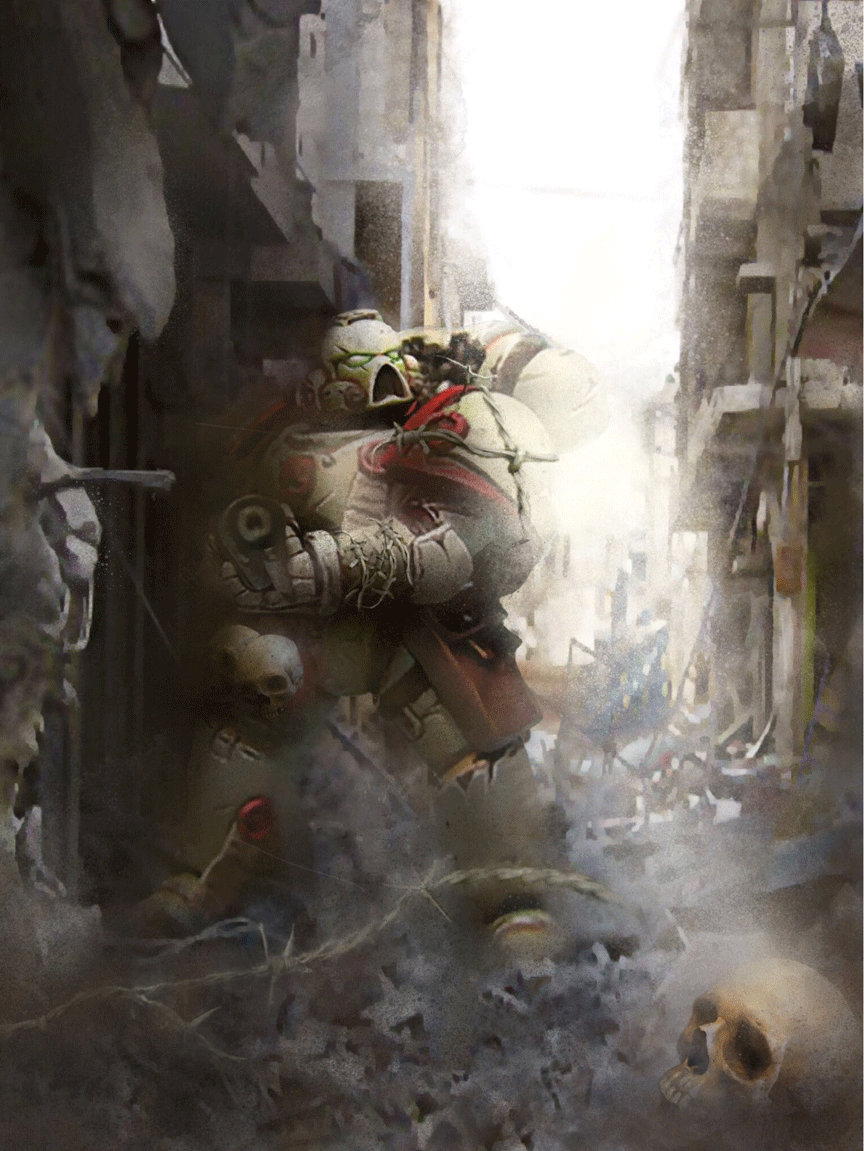
A pict of a Death Guard warrior during an assault on the planet Polarian’s second-largest city of Alistar. Tens of thousands of civilian casualties have been reported, and at least 2 million citizens have fled, although tens of thousands of refugees reportedly have died of plague or starvation. (Click on image for a larger picture.)
Traitors spread across Dozarian System
 After the Imperial Navy was driven out of the Dozarian System last year, there were fears the Death Guard invasion force on the industrial world of Dozaria would use their newfound control over the space lanes to attack and despoil the system’s other four planets.
An ultra-fast reconnaissance ship, sent by the Imperial Navy to make a quick run of the system and depart, has confirmed those fears. Although the vast Imperial army on Dozaria continues to hold out against the traitor forces, some traitor warbands have taken the opportunity to wreak havoc across the system.
The civilized world of Polarian, which previously had suffered only brief Death Guard raids, now is fighting against 50,000 invaders who are keeping their distance from the heavily defended cities of the planet and instead laying waste to the countryside.
“Our ship raced past Polarian and managed a brief communication with PDF forces on the planet,” Jamol Wythe, public liaison officer for the Imperial Navy, reported recently.
“Scores of smaller towns and villages have been wiped out, and the traitors and heretics are aggressively spreading warp-tainted diseases over as wide an area as possible.”
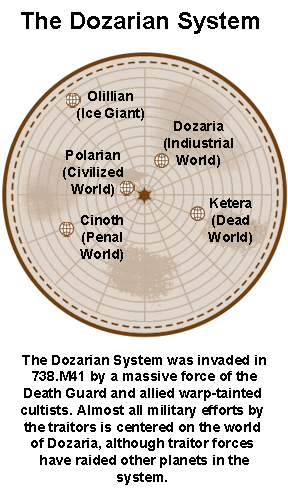 On the dead world of Ketera, the only inhabited community was an Adeptus Mechanicus mining facility tapping into a large heavy-metal deposit near the north polar region. It appears to have been destroyed.
A distress signal broadcast from the planet begged for aid against an attack by a 100-Astartes-strong warband supported by thousands of cultists. Since that signal, there has been no communications with the Mechanicus base.
A more ominous fate has likely befallen the world of Cinoth. More than 8 million Imperial citizens are serving life sentences on the penal world, and with only 300,000 security guards and their 1 million family members to maintain control, it would take only a small Chaos force to help the prisoners riot and overthrow Imperial rule, Wythe said.
“If this has happened, there’s little doubt that millions would turn heretic and traitor, and the Death Guard wouldn’t hesitate to throw these millions of new recruits into the fighting on Dozaria.”
Nothing is known of the orbital refinery platforms above the gas giant of Olillian. These massive refineries gather and process the planet’s atmosphere into exotic and highly useful chemicals that are used in many industrial endeavors, ranging from lubricating the massive equipment aboard voidships to hardening plasteel for armored vehicles.
“We hope these stations have been ignored as the Death Guard focus on more populated areas,” Wythe said. “But the value of these refineries will eventually draw the traitors’ interest—and provide a valuable contribution to their war effort.”
Imperial authorities have declined to discuss future plans to relieve these beleaguered planets.
—
The two illustrations of ork warriors were created using AI technology available on Night Cafe Studios.
The artwork of the Death Guard warrior is courtesy of Fredrik Eriksson. Click here to see more of his great artwork.
—
The Corvus Cluster is a Warhammer 40K blog documenting our gaming adventures in the fantastical sci-fi universe of Games Workshop.
Categories: War Zones


 THE CORVUS CLUSTER