

In the central chamber of the catacombs, the assassin Caliope attempts to protect the central objective from advancing cultists. She kills one but, as she turns her attention to a second cultist, she is shot from the shadows by heretical servitor armed with a heavy bolter.
“To serve a daemon is to condemn yourself. The daemon lies. The daemon betrays. The daemon exploits and damns. Those who fall into the worship of evil are not just evil themselves, they are fools who have condemned themselves to eternal damnation.”—Confessor Guidonis Bernard, militant priest fighting on Dozaria.
* * *
Success
On the left chamber, one of the acolytes gathered the courage to make a run for his objective. He reached it despite cultist fire, and quickly determined it had no value.
At this point, victory would be determined by the last two objectives: one closest to the cultists, and one closest to Gallus.
Ed. Note: At this point, the Imperial player played the rules. Two objectives were unchecked. If Gallus ran to his objective, he would need a 6 on a d6 to find the psychic key. If he waited, perhaps the cultist player would be tempted to grab at the central objective. He’d only have a 1 in 6 chance of finding the objective. Assuming he failed, the objective near Gallus would be the last objective—and would be the key. So, the Inquisition player played the odds and did nothing.
At this point, the terrain in the catacombs greatly favored the cultists. They had plenty of terrain for cover; the Inquisition less so.
The psyker Theatos finally made his presence known. Appearing out of the shadows, he advanced into the chamber and used witchcraft against Gallus. For a moment, the Imperial agent had a vision of nightmarish apparitions around him, but his psycho-indoctrination kicked in. Whispering a time-honored mantra of deflection, he managed to suppress the psychic vision and block Theatos’ attempt to break Gallus’ spirit and see him flee in a panic.
At the same time, a cultist raced for the central objective, a d6 was rolled, and the objective proved useless. Now Gallus knew the objective was before him and, in fear that Thaetos might be more successful with his next spell, he ran to the objective and found the psychic key.
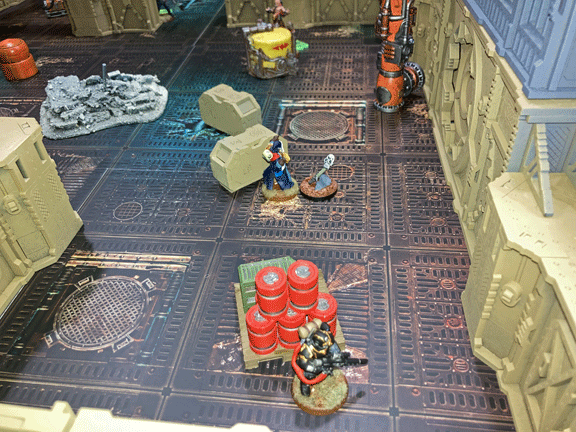
As Interrogator Konrad Gallus finds the hidden psychic key (center), the heretical psyker, Thaetos (top center) uses witchcraft to attempt to drive Gallus away. Thanks to psycho-conditioning, the Inquisitorial agent shakes off the mental attack, grabs the key, and retreats back to his nearby Stormtroopers.
Escape
At this point, the key to victory was simply for Gallus to escape the catacombs alive. His stormtroopers advanced to screen Gallus, making themselves easy targets as the Imperial agent used them for cover as he fled. (Ed note: The rules for Shadow War require models to fire at the closest target if in the open. The Imperial player took advantage of that rule.)
Theatos attempted to cast more witchfire, but he could not bring the spell to fruition in time. Cultist fire took down one stormtrooper, but the second wasn’t hit, and the black-armored warrior withdrew quickly but careful to use his body to screen Gallus.
As Gallus ran, he voxed the rest of his acolytes to fall back, and they did so successfully.
Victory belonged to the Inquisition.
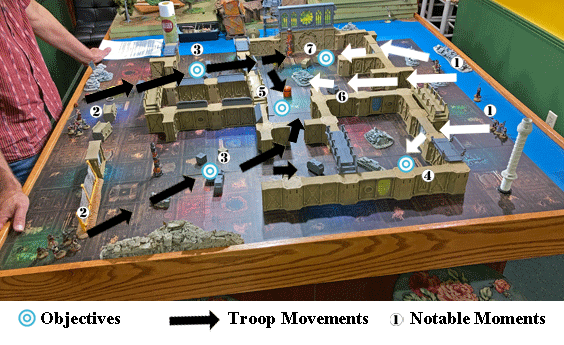
As the Inquisition and cultists teams advance on the center of the catacombs (1 & 2), the cultists find movement relatively easy, while the Inquisition are stymied by closed hatches. The cultists (3) are the first to begin their search and cover a lot of ground. By the time that one Inquisition team reaches an objective (4), they come under fire by advancing cultists and are delayed in their search. Cultists also reach the central objective first, but the Imperial psyker Mystic and the assassin Caliope contest the cultist’s advance (6). In a simple stroke of luck, Imperial agent Gallus finds the psychic key (7) and manages to escape the psychic attack of the cultist leader Thaetos.
Escape
Although Gallus escaped the catacombs, his success remains uncertain. As his team boarded their Arvus Lighter to make their escape, the cultists reached the surface and brought the elevating aircraft under heavy fire. One wing was severely damaged, and as the Lighter roared away, there was a loud “bang” and the aircraft’s engines failed.
Billowing black smoke, the disabled aircraft crashed only two kilometers away. The pilot successfully brought the aircarft down in a meadow, a controlled crash that allowed everyone to survive with only minor cuts and bruises.
Admittedly, this was a bit of plot fluff, as it leaves the ultimate success of the mission in doubt. Now Gallus must escape on foot, and one can be certain that Thaetos and his men will pursue with fanatical determination.
A rematch for the fate of the second psychic key is coming.
TheGM: This was quick and dirty scenario. Two forces racing to objectives in hopes of being lucky. The idea that a player would roll a d6 and succeed in finding the objective was a bit lame. But I found this objective rule in a Games Workshop scenario, and I realized it had an advantage. If one objective marker was pre-set as the key, a player might find the key when it checked the first objective—making for a very quick and unsatisfying game.
With only a 1 in 6 chance of finding the key, this victory condition meant it was possible to be very lucky (that’s warfare), but it also made it more likely that the key would be farthest from both sides (as both sides would be seeking a natural six for the objectives nearest their deployment zone (and thus almost certain to be captured by them).
As it happened, it was the last objective—and Thaetos had advanced quick enough to have a chance of seizing the key from Gallus (if his spells had worked, Gallus would have routed away from the key and kept ownership of the key in play). So the rule, while a bit silly, made the game more competitive.
Of course, I can’t just let the Inquisition take the second key without another fight. That’s unfair. The Kossogtha Campaign ends quickly if the Inquisition maintains control over even a single key. So, I need to give the cultists at least one chance of seizing back to second key. (They already have the first key.)
I’ll do the same for the third key. and, if the cultists take back the second key, and win the next battle for the final key . . . well, if the heretics can win two battles in a row, they will be allowed to keep all three keys. Of course, that means we need a climactic “last chance” battle to stop the arrival of Kosssogtha on Dozaria.
Personally, I’d like Kossogtha to make an appearance on Dozaria. It would reshape the stalemate that currently exists. But, while I might have a thumb on the scale (for narrative purposes), the fate of Kossogtha ultimately will be decided on the tabletop.
Click here to return to Part 1 of this fight.
—
The Corvus Cluster is a Warhammer 40K blog documenting our hobby adventures in the fantastical sci-fi universe of Games Workshop.
Categories: Kossogtha Campaign


 THE CORVUS CLUSTER
Great stuff. Thanks again for documenting these games. You might look at pulp alley for some mult objective inspiration. (It’s been a while so I might get this wrong). There are major objectives and minor ones. Minors are worth 1pt, and major are…..3pts(?).
Narratively it could be there are enough clues to put together what was in the main objective. Pulp alley also calls for skill tests (hazard tests) to actually recover/pickup the clue. It means the main characters are very valuable to grab the objectives while the mooks can struggle for a while.
LikeLike
Thanks for the idea. Always looking for inspiration. The idea of skill tests is particularly interesting.
The Gaffer has a thing about Cthulhu and wants to incorporate a bit of that mythos into “his” planet of Regno Borealis. So my little mini-campaign for the Inquisition deals with Kossogtha, which actually is an official Cthulhu-type god (there’s a disease element that fits in with Nurgle).
If I do a future mini-campaign surrounding the Inquisition or Arbites, I’ll plan it out better. With the Kossogtha Campaign, I’m kind of winging it, pulling together a scenario I think is quick and fun. Still, I could build up the “mood” a bit and make the victory conditions more interesting.
Thanks for following our now 11-year-old adventure.
LikeLike