
 It’s hard to believe. The Corvus Cluster is 10 years old.
In the past decade, we’ve published 653 articles and written nearly 700,000 words. We’ve fought—and reported on—nearly 200 tabletop battles, published the artwork of dozens of artists, and our site has been visited by more than 59,000 visitors from around the globe.
Now, these statistics might pale against those of, say, a Taylor Swift fan site. But it’s amazing to us.
You see, the Corvus Cluster was never intended to attract visitors. We don’t focus on such popular topics as painting or terrain building, and we rarely review products.
Instead, our goal was to create a backdrop for our tabletop battles. We didn’t want to play “one-off” games that we’d soon forget. We wanted every battle or fictional story to help create an ongoing story. We wanted each battle to mean something to our overall gaming experience.
It’s worked far beyond our initial expectations. Slowly, our battle reports, biographies of various heroes, fictional stories, and encyclopedia-style articles about planets and the politics of our setting have created an immersive universe. A universe where the story continues with new every entry written.
Let me share a few examples:

Six years ago, in a controversial move, the Imperial Navy bombarded ork-controlled cities on Hegira to cull the ork population as the xenos began to win dominance over the world. The entire southern half of the planet is now an irradiated wasteland.
Our campaign is very immersive
By way of example, the Gaffer and I have fought 20 or more battles on the desert moon of Hegira. At one time, the orks were advancing steadily. Then the Imperial counterattacked and drove the xenos back. Now, the greenskins have retaken all their lost territories and stand at the gates of the capital city.
There’s a bit of a grudge match going on. After watching so much carnage on the tabletop, I see the ork warlord, Rumlar, as a monster. The Gaffer sees him as the apex predator, and he’s out for blood.
We know that, if the orks take Hegira, they’ll advance to another world in the Sculptor System. Rumlar will be one step closer to a full-scale Waaag! that could destroy many of the worlds we’ve worked so hard to develop as individual stories.
What’s more, a lot of wonderful characters will have to be retired. Oh, senior Imperial military officials can be evacuated if the greenskins win. They will continue to fight. But the civilian characters won’t really have much more of a role in the continuing story. They’ll fade away.
At the moment, things actually are heating up. The orks need to drive north, and they can do so in the Sea of Dust—or by conducting an amphibious invasion of Port Hinga on the north side of Hegira’s only sea.
There’s anticipation in the air.
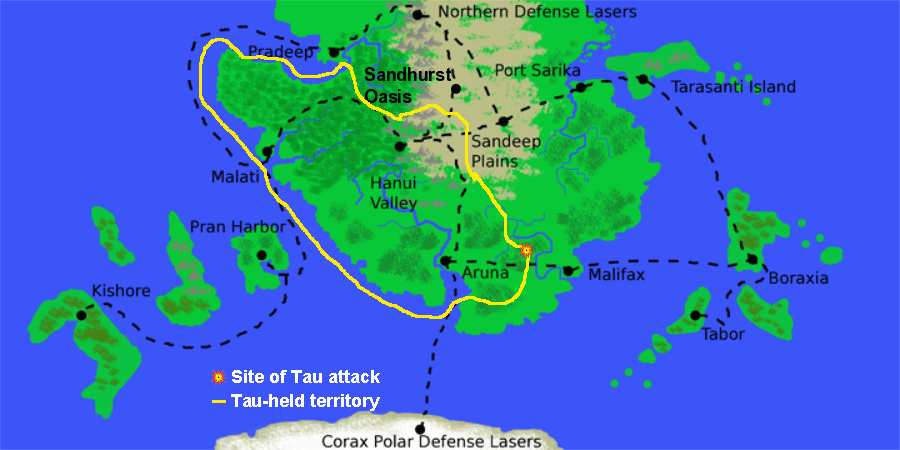
This map shows the extent of Tau control of the agri-moon of Dar Sai. As you can see from the typography, if the Tau seize the port of Malifax, their southeastern flank will be secure. Thus, the details of the campaign determine the Tau commander’s decisions: The flank must be secured, so the Tau can shorten the front and concentrate their forces on a northern thrust.
World-building is fun
We didn’t plan it. Yet, as we started writing up encyclopedia-style articles about the worlds where we were fighting, the stakes seemed to climb.
There’s something psychologically influential about having a background of our planets. They seem “real” on some level.

Orks and the Imperial Guard have been fighting over Hegira for a decade (in real life, too).
I believe the psychological term is called “transference,” and it may be subliminal (and not based on reality). Still, when something becomes important to you, it can have a powerful impact on your attitude. We are very fond of our worlds. We don’t want them to fall to the enemy. (Unless we’re the invader, of course.)
These world-building articles also inspire us. For example, we developed the map of the agri-moon Dar Sai simply for fun. But once we put mountains, forests, and cities on the map, those details dictated the story of the Tau’s advance across the moon. First, the xenos moved west and seized ports of Volantis and Malati, then they moved south to Port Aruna.
Next, the Tau have entered the Great Forest of Dar Sai in a bid to seize the port of Malifax—and to secure their east flank.
So, here we are: The Tau and Imperial Guard battling it out in heavy forests and crop-covered agricultural plantations. Our tabletop terrain is dictated by the story we’ve created.
Our characters matter to us

High Marshal Ioculus
During the Tophet Campaign, High Marshal Ioculus of the Knights of Altair Space Marine Chapter arrived on the planet as a savior.
Previously, every Imperial Guard battle against the invading Necrons had ended in defeat. But Ioculus led his Space Marines to victory in every battle he fought—and ultimately won this campaign-within-a-campaign by driving the xenos off the planet.
That made me, as silly as it sounds, very proud of Ioculus, and I developed a real fondness for him.
On top of that, his nemesis, the Necron Overlord Agamunzu, also became real. I wrote a short story called, “A need for revenge,” that gave us a glimpse of his fury at his defeat—and thus his small, one-inch-tall plastic model became a very real, very dangerous opponent that my hero Ioculus would fight again.
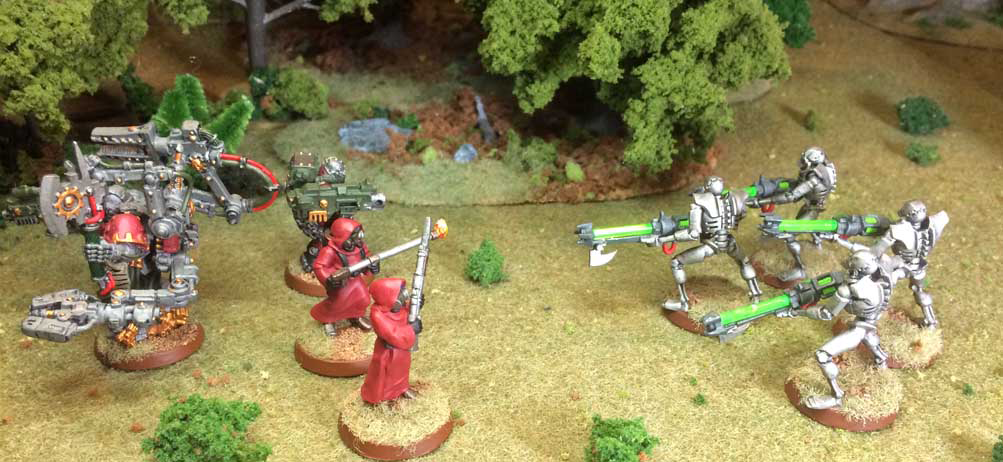
After awakening a sleeping Necron Tomb World, Magos Abnightus uses his Skitarii and servitors to screen his retreat.
Storytelling takes you in directions
that you don’t expect
It was never my intent to build a Necron army. But I painted up 20 Necrons for a small skirmish game that became a battle report called the “Pyramids of Stigmata.”

Necrons and Space Marines fight for control of an Imperial space station that was not responding to Imperial inquiries. As the Inquisition expected, the Necrons were involved.
In this supposedly one-off game, the premise was that Rogue Trader Adeon Drake and a tech priest known as Abnightus visited a quarantined world to steal xeno technology abandoned millennia ago. But what they actually did was awaken a sleeping Necron dynasty.
Drake and Abnightus escaped the planet, but I thought it would be fun to write up a few “news reports” of small colonies being wiped out by a mysterious foe, sightings of strange xeno warships, and other ominous happenings—all in the vicinity of the planet Stigmata.
That led to a second small skirmish action in which an Inquisition agent visited a silenced space station. There, he was attacked by Necrons, and the xeno threat led to the creation of the Dryilian Quarantine Zone.
By that point, I’d found myself painting up “a few more” Necrons for the every-larger battles being fought, and then I needed a half dozen Necron ships for a game of Battlefleet Gothic.
Without intending to, I found myself with a sizable Necron force—and an entirely new war zone in the Corvus Cluster.
My point is this: A narrative campaign eventually takes on a life of its own. The narrative of the story begins to dictate what happens next. It’s wonderful.
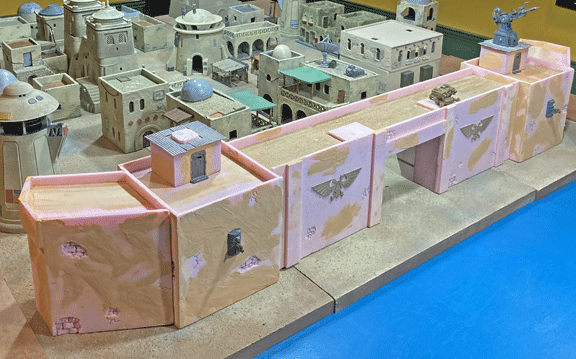
These still-under-construction walls were inspired by the idea of protecting urban centers on the many desert worlds of the Corvus Cluster. It also was built for an Armageddon-sized battle for Hegira’s capital city. The central gate piece was made twice–one intact, and one collapsed should ork gunfire create a breach in the defenses.
The story dictates our terrain building
I’ve already mentioned that the orks on Hegira are gearing up for the final battles of this 10-year mini-campaign. But our excitement over this reality has influenced the terrain we’re building.
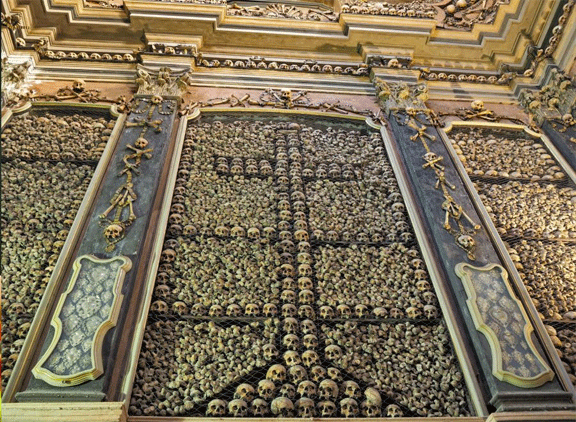
If the orks attack the Monastery of the Emperor’s Light, they will desecrate its gothic architecture. So, we need some ruins to represent the vandalism and destruction.
The orks already are pressing the Imperial defenses in the Sea of Dust. One key terrain objective will be the Monastery of the Emperor’s Light, a fortified religious center. So, I’m busy building ruins to replace my intact buildings, which surely will be pummeled by the orks as they storm the monastery in what will be a nasty, densely urban City of Death fight.
Meanwhile, the Gaffer is building landing craft for an amphibious invasion against Port Hinga, and I need to paint up some city dock defenses. (We’ve already built the dock.)
None of this terrain building would have happened if the story didn’t dictate it.

The story doesn’t just impact our terrain building. These two miniatures were built after our blog’s followers offered suggestions about the future. In appreciation, we “honored” them by creating avatar characters—Petrov Karlson, the former mayor of Port Aruna, and Lecia Athena, a Tau sympathizer. Then we created models and fought battles with them serving as the protagonists.
In Conclusion
I can go on and on. I never intended to build a Death Guard army—or create the war-torn world of Dozaria, which is now a major mini-campaign in our narrative. I didn’t intend to write a series of short stories about Private Tyesha Levers of the 728 Cadian Regiment.
I never intended to build specific models of two Dar Sai characters: the Tau sympathizer, Lecia Athena , or of Petrov Karlson, the former mayor of Port Arunda and now a guerilla leader fighting the Tau on the moon of Dar sai. Nor did I intend to write up battle reports that featured their characters.
But two of this blog’s followers contributed some great ideas and, with their permission and input, I was inspired to create these two characters as their avatars. I converted some miniatures to represent the characters, and I’ve fought some battles and written some articles about these characters.

Adeon Drake
So, here we are. Ten years of tabletop battles, a massive encyclopedia of information on the background of our campaign, and a narrative story that has taken on a life of its own. We do not know exactly where the story is going next.
It’s almost as if the story is a living thing.
And perhaps that’s why there are people follow our campaign. Battle reports and fictional “fluff” aren’t for everyone. But there are enough hobbyists who get a kick out of seeing what’s next in our little corner of the galaxy. Hobbyists from around the world.
(One hobbyists who discovered our site actually has read, in a matter of weeks, every single article we’ve written.)
So, congratulations to the Corvus Cluster for making it to 10 years. And, given the continued enthusiasm we feel for our narrative campaign, I think there’s a fair chance we’re got another 10 years in us.
I, for one, can’t wait to see if the orks finally take control of Hegira. And will the Death Guard conquer Dozaria? What will be next adventure of Rogue Trader Adeon Drake or Inquisitor Georgene Serillian. And, a real treat to come: What about when the Tyranids make an appearance next year (Hive Fleet Behemoth arrives in the segmentum in 745.M41. That’s just two months away.)
We’re very happy that so many of you have followed our decade-long story. And we’re grateful for your, as well as the many artists around the world who have supported us by allowing us to use their artwork. (It’s certainly enriched our hobby efforts.)
There’s a lot more to come. I hope you stay tuned.
Cheers!—TheGM
—
The Corvus Cluster is our decade-long Warhammer 40K narrative campaign that documents our gaming adventures in the fantastical sci-fi universe of Games Workshop.
Categories: FromtheGM


 THE CORVUS CLUSTER
Rock on!
LikeLike
its a pleasure and an inspiration, thanks everyone!
LikeLike
An amazing achieve and an inspiration to all of us who crave narrative games.
LikeLike