

Mutants continue to burn small desert villages that refuse to accept rebel authority.
It has been nearly two years since mutant rebels seized control of the Thar Desert Basin, the barren and backwater region that surrounds the ruined city of Ungolath.
During the fighting of 740-741.M41, the mutants showed surprising tactical ability and, over the course of six battles, drove PDF and Skitarii forces out of the basin. Imperial casualties were heavy.
This military reverse shocked the planet’s Council of Electors, but equally disturbing were reports of a sizable force of armored vehicles within the mutant army. That suggested the long-abandoned manufactorums of Ungolath were being put to use by the rebels to equip their small army.
Since the defeat of Skitarii forces at the Tomada Drill Site (741.M41), large-scale military activity has been non-existent. But violence and atrocities on a small scale have continued.
Any uneasy calm
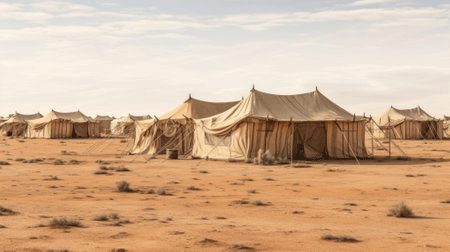
Imperial propaganda suggest Ungolath is surrounded by formidable Imperial fortifications, but the reality is that many bases are little more than tent cities—and lack even the most basic defensive works.
After it became clear the rebel offensive had ended in the Thar Desert Basin, senior planetary officials recovered from the shock of their defeat and began to focus seriously on how to meet the growing mutant threat.
With front-line troops in disarray, General Marwan Sayar, senior officer of the Planetary Defense Force (PDF), established a series of fortified positions around rebel-held territory and reinforced them with fresh troops. A new recruitment program was launched with the goal of expanding the PDF by six regiments of 20,000 men each.
Within a year, these new regiments were organized, but poor management has hampered efforts to equip these troops with the necessary weapons and equipment. What’s more, training for these troops has been short-changed, with reports that regimental officers have hired out these troops as laborers, an act of corruption that Gen. Sayar has yet to properly address.
While the planetary government has made a clumsy effort to prepare for a new round of fighting, the activities of the mutant rebels are anything but clear. It is suspected that the rebels have been regrouping and re-equipping their forces for a renewal of fighting.
Less clear are the rebel intentions. Although it seems inconceivable the mutants actually believe their broadcast rhetoric—that they intend to overthrow Imperial rule—no one expected two years ago that the rebels would go on the offensive and repeatedly defeat Imperial troops. An underlying dread has since permeated the planet’s populace.
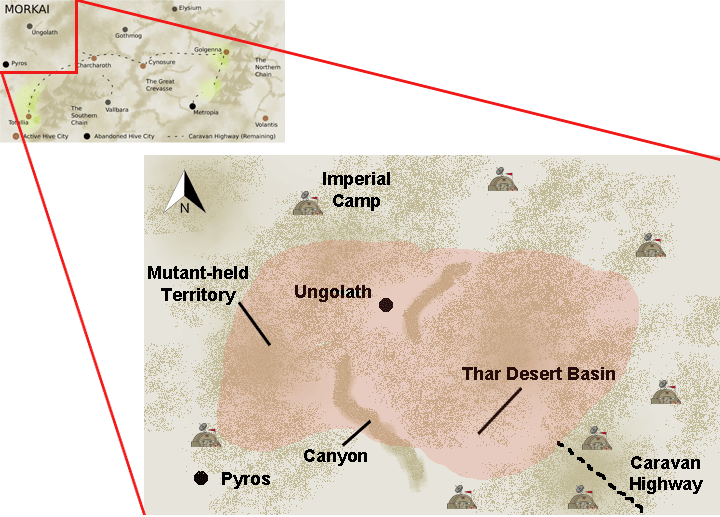
The Imperial camps surrounding Ungolath are isolated, lacking the ability to provide timely support to one anogher in case of mutant attack.
Rebel consolidation
After the Imperial defeat at the Tomada Drill Site, Imperial troops retreated out of the Thar Desert Basin. To the relief of Imperial military commanders, the rebels—likely exhausted and at the end of their supply lines—ended their offensive and spent the past two years consolidating control over their newly conquered territory.
Scores of towns and villages were forced to submit to the mutant rebels, whose treatment of civilians varied with the tribal clan that seized control. In some communities, citizens were permitted to carry on with their lives without interference. In others, citizens were enslaved, driven from their homes into the desert, or slaughtered for no reason.
The same inconsistent treatment was suffered by thousands of small moisture-collection farms, small promethium facilities, and nomadic tribes in the region.
In one celebrated instance, a moisture-collection operation known as Ma Sophia’s Farm came under attack for no apparent reason. Although farm workers managed to repulse the mutants, the threat of future attacks prompted its owner to shut down operations and lead her workers south to the safety of the Hive City of Charcharoth.
Still, although some estimate that the rebels have gained control over 10 percent of the planet, this control is symbolic at best. The vast majority of rebel territory is barren wasteland, and the rebels rarely deploy troops to patrol this vast area.
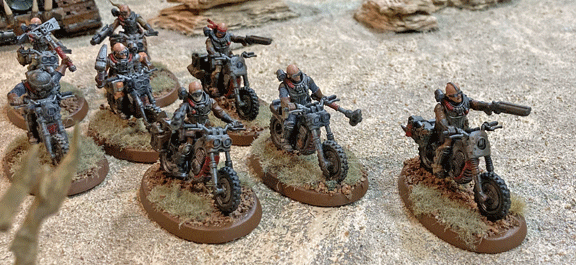
Although avoiding battle, rebel bikers—called “Jackels”—occasionally patrol rebel-held territory. As most of this territory is barren, actual control of the desert sands often is more symbolic than practical.
A slow Imperial recovery
Despite a two-year respite in fighting, the planetary government has not used this time as well as many would like. In addition to the troubled expansion of the PDF, the ring of fortified positions around mutant-held territory is not as impressive as Imperial propaganda suggests. The term “outposts” might be a more accurate description.
Some of these outposts are little more than a ring of trenches in the desert. Troops live in tents and suffer greatly from the heat, and fiber-mesh tent walls offer no protection from the occasional mortar bombardments by rebels that are designed to keep PDF troops on guard and stressed. Troop morale is low.
What’s more, hundreds of kilometers of barren desert separate each outpost. If a serious attack was launched against one, it could take hours or even days for motorized troops from another outpost to provide aid.
Corruption is another serious problem. Although such information is limited to only the most senior government officials, it is estimated that only half of the weapons output ordered by the government has been manufactured, and the remaining government funds have disappeared. Officers in charge of training new recruits, meanwhile, report that these recruits have been drawn from the dregs of society, and nearly one-third are not physically fit to serve.
Senior Administratum officials say they are working to correct these problems, but the reality is the government is struggling with pervasive corruption—and military preparedness has not shown any significant improvement.
The Pyros Infiltration
After two years of relative peace, the alarm felt government officials gradually faded, and political intrigue, corruption, and self-promotion in the Imperial court soon took precedence over responding to the mutant threat.
Even Gen. Sayar, whose attention was on establishing his military perimeter around mutant-held territory, failed to grasp that the millions of square kilometers of desert allowed rebel infiltrators to spread their influence across the planet.
One of the most damaging effects of that oversight was growing mutant influence in the ruined hive city of Pyros. Although long abandoned by the Imperial government, the city is far from empty. Although largely in ruins, the city remains home to the decedents of former manufactorum workers, the city’s criminal element, a large mutant population, and desert tribesmen who moved into the half-empty city after its collapse.
The first rebel infiltrators targeted their fellow mutants, offering food and technical assistance to rebuild the city’s infrastructure. Word spread of this seemingly benign charity, and the infiltrators soon established trade relations with normal humans. And, all the time, the infiltrators talked of the injustice of the planetary government and the need for a new government dedicated to the people’s needs.
Over time, rebel troops began to appear, ostensibly to maintain law and order but eventually to enforce growing rebel oversight of the city.
By the end of 743.M41, mutants controlled approximately half the city ruins, and military intelligence officers estimate it would take several PDF regiments to attempt to regain control—an expensive prospect that government officials currently are not willing to consider.
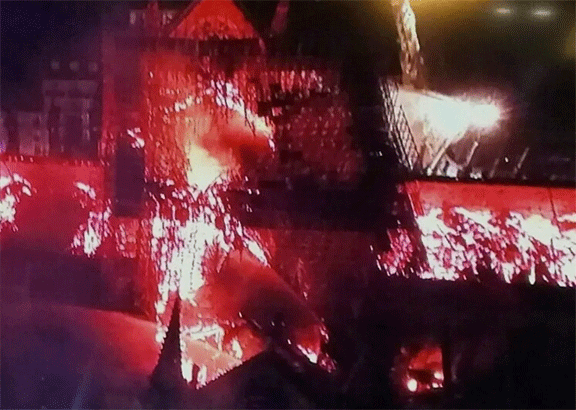
The Temple of the Emperor’s Light, one of the most noble holy sites in the hive city of Golgenna, is consumed by flame after a terrorist attack by mutant rebels.
Wave of Terrorism
At the same time, mutant rebels have attempted to keep pressure on the planetary government using guerrilla tactics.
A number of mutant clans have dedicated themselves to asymmetrical warfare, and their operatives—working subversively amidst the general population—are overseeing a campaign of bombings, assassinations, sabotage, and the incitement of civil unrest.
The capital city, Golgenna, has been a prime target for such activity. In late 741.M41, Administratum Master Malik Yasin was assassinated by an improvised explosive device placed in his private transportation vehicle. Two riots related to food shortages in early 742.M41 are attributed by the Adeptus Arbites to instigation by rebel operatives that originally sabotaged the food transportation system to create the food crisis.
Just months ago, 50 rebels conducted a raid of a cargo train and escaped with 10 metric tons of valuable supplies, including military-grade cogitators. That rebels could successfully pull off such a brazen attack is a clear sign that citywide security efforts are proving inadequate.
If this guerrilla/terrorist activity is not curtailed, public confidence in the Imperial government could decline, with a resulting increase in civil unrest and the threat of growing support for the rebels.
Long-term assessment
Both military and Arbites assessments of the strategic situation rate the rebel threat as moderate. There is no immediate threat to Imperial control of the planet.
Still, there are significant failures in military preparations for renewed military activity and in the civilian government’s response to the asymmetrical warfare being waged against the civilian population and government officials.
If these weaknesses in the Imperial response are not corrected quickly, it is possible that the rebel threat may grow.
+ Analysis Complete +
—
The Corvus Cluster is a Warhammer 40K blog documenting our gaming adventures in the fantastical sci-fi universe of Games Workshop.
Categories: Morkai Campaign


 THE CORVUS CLUSTER
Fantastic- I love to see this side of campasigning in the 40k world that is miles away from the ‘Brother Space Marines against giant galactiuc threat’ usual battles.
Keep up the good work.
Cheers,
Pete.
LikeLike