
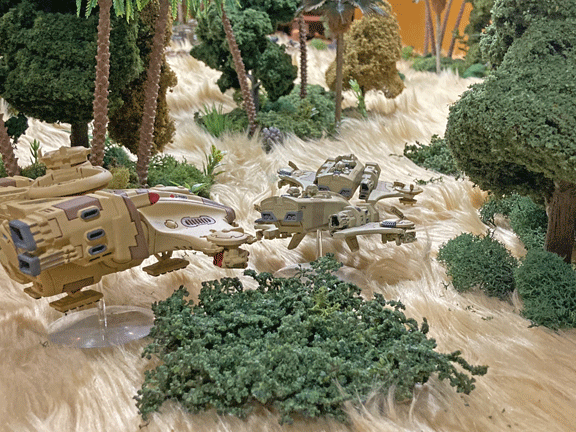
Tau skimmers traverse a jungle clearing. This is a mock-up of a corner of the game table that I’m bringing to the Shorehammer convention. The tall grass is teddy bear fur, and but I have yet to shave out roads or add a green tint to the fur.
TheGM: Although I have months to prepare my jungle table for the Shorehammer Convention, I’ve gotten an early start on play-testing the scenarios that I’m hosting.
What has play-testing to do with terrain? Everything.
It’s not enough to built nice-looking trees and scatter terrain. Or painted buildings or a nice battle mat. All are important. But if the games don’t play well, the most beautiful table is a bit of disappointment to your players.
You see, the placement of terrain must accentuate the playability of the game. You don’t want a large copse of trees to hamper the ability to players to handle their troops, and the models should not fall on their sides because they won’t stand upright on a pile of rubble.
What’s more, terrain must accentuate tactical decision-making. Terrain should create options for movement, where to seek cover, or where to place a firing line. Where you place your beautiful terrain is as important as its appearance.
First Play-test
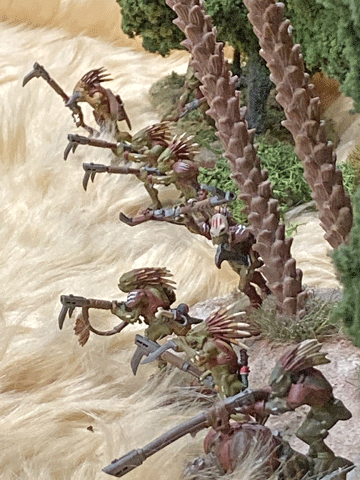
Kroot warriors advance out of the jungle and into the tall grass.
Case in point: One scenario I’m hosting at the convention is called HQ Under Attack! It simulates a combined Tau-Kroot assault on the headquarters of an Imperial Guard regiment.
The first play-test fell flat. And terrain placement was a major reason. There was only one good path for the Tau to advance, so the terrain dictated the first tactical decision of the xeno players. It also made it obvious where the Imperial players should deploy to defend themselves.
The limited options for maneuver also hurt the Imperial players. There was no easy way to advance on the xeno flank or send an assault team to threaten a high-value model. Thus, the Imperials’ best option was to simply sit back and defend.
In other words, a boring game. The only obvious option for the Tau was a a frontal assault, and the Imperials’ best option was to embrace a static defense. There really wasn’t anything to do but roll buckets of dice to get a result.
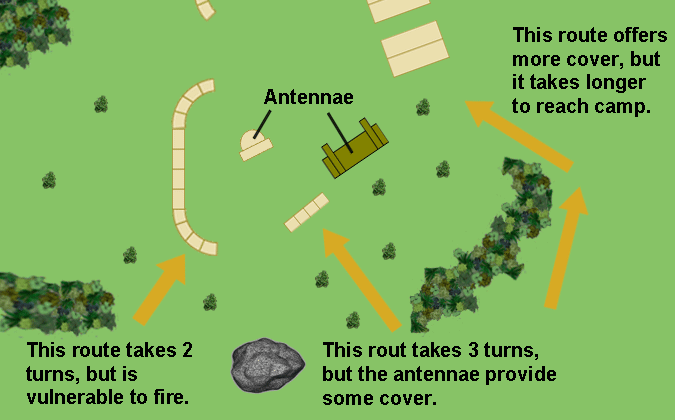
Creating as many tactical options for players is key to a good convention table, and terrain is one of the best ways to create those options.
Rules to Follow
So, how could I adjust the terrain to maximize the tactical decision-making of players? I turned to a few obvious rules:
Rule #1: Create choices: A good game table forces players to make decisions every turn. There must be multiple avenues of attack, and each should offer different advantages and disadvantages in its selection.
In my first play-test, for example, my terrain placement left a Kroot squad with but a single avenue of attack—across open grassland dotted with brush for cover. (See the middle route in the illustration above.)
In the second play-test, I made three terrain changes to create more options.
The first new option was on the left, where I moved forward a copse of trees. This created a new route that, although it still required the Tau to cross open grassland, the xenos would be in melee with the Imperial defenses by the second turn. The disadvantage was that the Kroot would come under significant Imperial fire.
The original option, in the center, took three turns to cross. But I added more brush for light cover, and I placed two antenna arrays in Imperial camp to block the line of fire for some Imperial troops.
Now. this route had the advantage of allowing the xenos to advance while suffering less Imperial fire, but the tradeoff was that it took an extra turn to reach the Imperials.
The third route was created by adding a tree line that curved around the right side of the Imperial camp. The advantage of this new route was that the Kroot could advance safe from Imperial fire, but it would take five turns to reach the camp. For that time, the xenos could not affect the course of the battle, and it gave time for the Imperials to react.
Creating three routes gave the Kroot player something to think about—to weigh the pros and cons of each approach.
These changes also forced the Imperial players to weigh new options. If the Kroot advanced behind the tree line, did the Imperials want to redeploy some troops out of their nice foxholes to avoid being outflanked? If the Kroot used the antennae to screen their advance, did the Imperials want to advance to bring the xenos under fire before they came into charge range?
As you can see, these changes created a variety of options for both players. The Kroot had to weigh the pros and cons of each route of attack, and the Imperials discovered that waiting in their foxholes might not be the best option in some circumstances.
Hopefully,the new terrain will invoke lots of thinking—and a lot more fun.
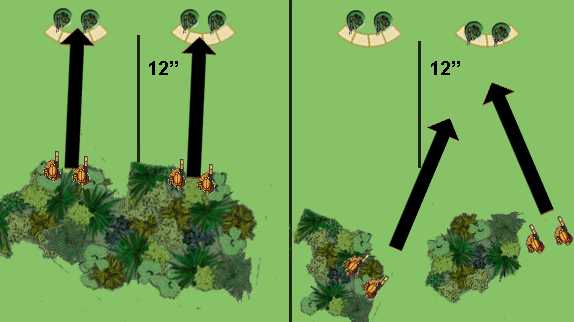
On the left, Tau and Imperial troops both have Line of Sight (LOS). But given the Imperials are in heavy cover and have a to-hit bonus at 12″, the Tau are at a disadvantage. By moving the trees back a few inches, the Tau have a better chance of winning a firefight. What’s more, the break in the terrain can be used by the Tau to block the LOS of some Imperial troops and allow the xenos to concentrate their fire on only a part of the Imperial line. The right tactics will give the Tau the advantage, and the Imperials will need to shift troops, counterattack, or fall back.
• Rule # 2: Think Line of Sight: In my scenario, I need to meet two goals: There needs to be open areas on the table that give both sides sufficient line of sight (LOS) to engage in some long-distance fire—to whittle down the enemy before the camp is assaulted. These open areas also pose tactical challenges to players whose troops are exposed. If you cannot out-shoot your opponent, do you want to be there?
There also needs to be areas of cover (tree copses, hills, bushes, etc.) that limit ranged fire. Some bushes or wreckage or hills that allow an attack to advance with some safety, while posing a challenge to the defender who must seek out some way to negate such a threat.
My previous examples apply here. But there was another issue with my original table that I didn’t spot until playtest #4. I had a copse of trees within 12″ of the camp’s outer foxholes. These trees allowed the Tau to approach unhindered by Imperial fire.
It turned out, though, that this distance actually hurt the Tau. Using a simplified version of Kill Team, the Imperials a +1 to-hit at targets within 12″—an overlooked factor that negated the cover of the jungle. Thus the veteran Imperial guardsmen hit on 3+, while the Tau—firing at an entrenched enemy—need a 6.
Okay, that situation was a bit skewed. I didn’t notice it because the Tau weapons are so powerful, they wound on a 2+. But what good are powerful weapons if the Imperial troops have a 66.66-percent chance of hitting the Tau, while the xenos have only a 16.66-percent chance?
So, what was the solution? Still working on it. I’ve moved the jungle back to 13″ from the outer entrenchments, and we’ll do another playtest.
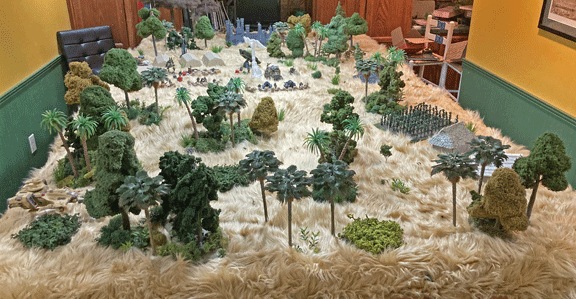
This mock-up of the final convention table is subject to change as I play-test the scenarios. I need to determine where the trees are best placed, as well as where roads and trails are needed. Another potential problem: In this iteration, I break my rules about playability. Some trees are too close to the table’s edge and may get in the way of players. Lots of changes still to come. (The grass also needs tinting green.)
Rule #3: Consider Playability: You don’t want terrain to “get in the way.” Put a copse of trees at the table’s edge, and you might find players’ elbows constantly knocking them down.
You also don’t want terrain so dense that it’s hard to reach into it and maneuver your models—or your city rubble is so realistic that the models won’t stand upright. People may”ooh” and “ahh” over your terrain when they walk up to the table, but they’ll be cursing it 20 minutes later if the terrain is bothersome.
That’s why my table simulates the edge of a tropical rain forest. What I expect to be the busiest areas of the table (where most of the fighting will occur) is savanna—open grassland. The jungle forest extends into this grassland in the form of thin tree lines that follow small streams or copses of trees in low-lying areas where underground water would be more accessible.
These smaller tree groupings will make it easier for players to reach their models.
To accentuate the jungle theme, though, I’m working on some massive rain forest trees (15″ to 18″ tall). The canopy of these trees will so tall that it should be possible to move models beneath them without much difficult, but I see these trees more as a pretty backdrop—a visual reinforcement of the setting.
So, in keeping with the idea that terrain should not “get in the way,” I’ll put these trees in an isolated corner of the table where they should have little impact on the fighting or interfere with players’ ability to maneuver their troops.
Finally, I’m using teddy be fur—stained green—to simulate the grass. That could pose a problem for players in keeping their models upright, so I’ll be adding metal weights under the bases to give them a low center of gravity. They should stand up easily even in the tall elephant grass.
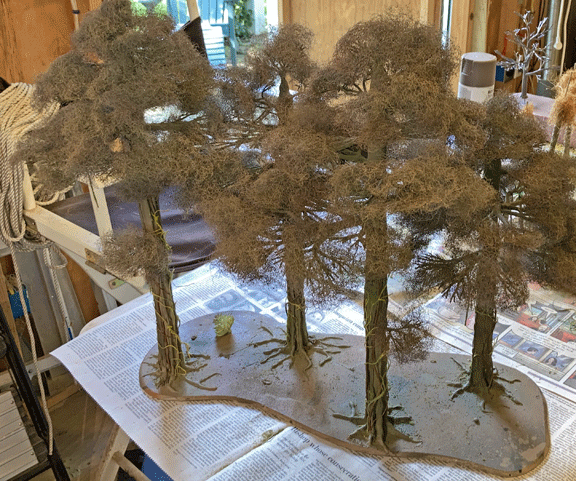
To accentuate the jungle theme, I’m working on 15-inch to 18-inch-tall rain forest trees. Although troops can pass beneath the tall canopies, I’m thinking of placing these trees in a quiet corner of the table to serve as a backdrop to the game play.
Better terrain
My later play-tests were more successful. The quality and quantity of the terrain didn’t change. Only it’s placement. Yet it made all the difference. Players have more choices to make, and the fighting is more dynamic and mobile.
Any veteran gamer will have some familiarity with the rules I’ve mentioned. But, by sharing my thinking, I hope I remind you to give more thought to how you place terrain for your next battle. I really does matter, particularly if you’re designing a scenario to host at a convention. You want people to have a good time.
That’s why I’ve got a lot more play-testing to do. I’m hosting eight different scenarios at the convention, and I must ensure my terrain is just as well placed for those games as I hope I’ve accomplished for HQ Under Attack!
—
The Corvus Cluster is a Warhammer 40K blog documenting our gaming adventures in the fantastical sci-fi universe of Games Workshop.
Categories: Terrain


 THE CORVUS CLUSTER
Looks great so far.
LikeLike
Thanks. I’m trying.–TheGM
LikeLiked by 1 person
I’m impressed how much you have invested to make the con a success. Will you be posting the tree tutorial?
LikeLike
I’m planning to write something about building the rain forest trees, but I’ll put up a small post on how I made my “plug-in trees,” as well.
Thanks for asking.–TheGM
LikeLike