
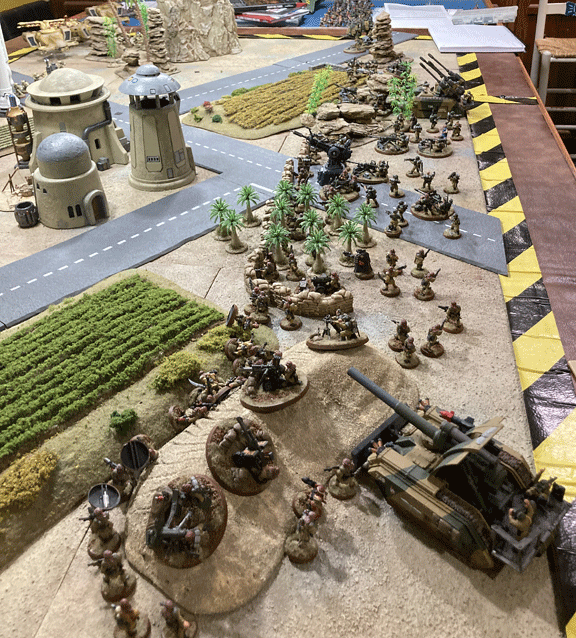
The battle began with a vanguard of Tallarn and Cadian infantry advancing on the Tau defensive position.
IMPERIAL VOXCAST—In the face of fierce xeno resistance, ground forces of the Damocles Gulf Crusade report mixed progress in their latest attack on Dal’yth Prime, a strategically important planet in the Tau Empire.
New dispatches indicate a major battle is underway for control of a xeno city called Gel”Bryn. Crusade ground troops are attacking in three major columns: One is dominated by the Titans of Legio Thanataris, the second spearheaded by veteran light infantry such as the Rakarshan Rifles Regiment, and the third by Space Marines.
“All attacking forces report heavy fighting as they advance, but our troops are certain that the xenos are doomed,” Captain Jamol Wythe, public liaison for the Imperial Navy, announced at a news conference this morning. . . . .
+ + +
Fourth column goes unnoticed
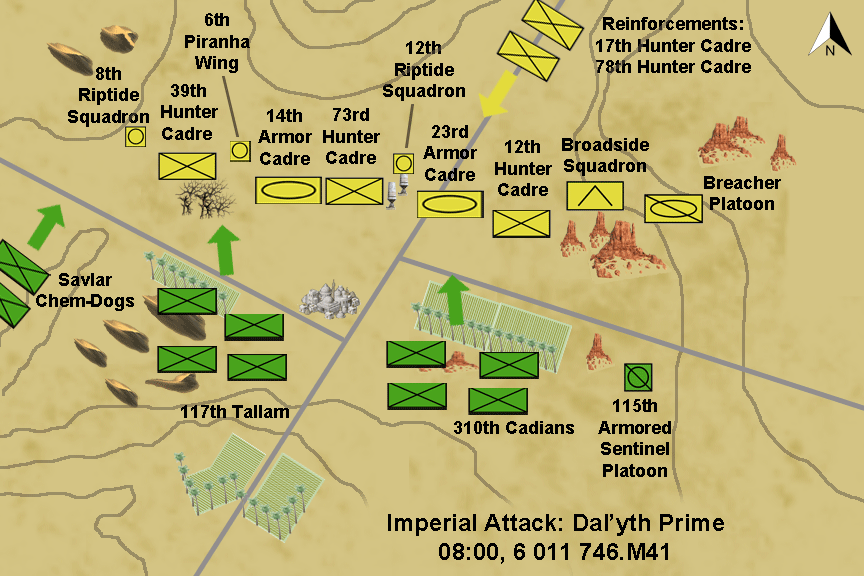
The Imperials used a “human wave” attack of massive numbers of guardsmen supported by heavy weapons teams. At first, the tactic seemed promising. Click on photo for larger view.
Not noted in Imperial announcements is the story of a fourth attack column, spearheaded by the 310th Cadian Regiment, 117th Tallarn Regiment, and the 93rd Savlar Chem-Dogs.
Over the course of two previous battles on Dar Sai—the initial expansion of the Imperial landing zone and a fight for control of a Tau research center—a significant portion of these regiments’ armored assets were destroyed or disabled.
When tasked more recently with the duty of guarding the Space Marine’s flank as it attacked along the coast, Colonel Willem Vance, brevetted to command a three-regiment ad hoc brigade, realized that he could not rely on armored support for this support role.
As a result, he hastily reorganized the three regiments under his command to enable what he described as “a human-wave attack that had at least a chance to accomplish something without a useless slaughter of men.”
To that end, he consolidated as many heavy weapons as possible—lascannons, auto cannons, and heavy bolters—into the vanguard companies of the attack. This led to an ugly behind-the-scenes bureaucratic fight, as Vance confiscated such weapons from as many reserve and rear-line and auxiliary units as possible, even if they were not specifically under his command.
Human wave tactics surprise Tau
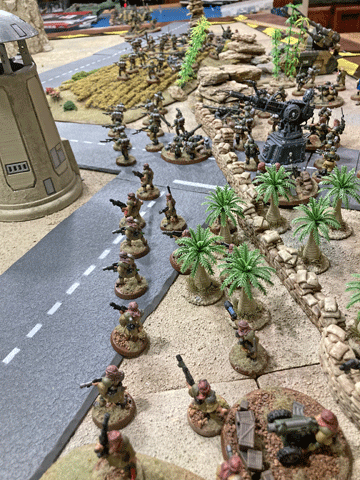
Guardsmen begin their advance across open ground in hopes that their massive numbers would prove too difficult to kill before the Imperials closed with their xeno enemies.
On 6 011 746.M41, the newly organized 4th Brigade began its attack toward Gel’bryn through a region of low hills, croplands, and orchards and engaged a xeno force of armor, 10-meter-tall walkers, and infantry.
At 08::00, the sound of whistles rose across the Imperial line, and more than 7,000 men rose and began a quick walk across the semi-arid landscape. Behind them, batteries of Basalisks fired earth cannons that pounded enemy positions with high explosives and smoke canisters designed to obscure the advance of friendly troops.
Although controversial, a wave attack attempts to overcome the enemy through sheer numbers. In the first hours of advance, Willem’s plan appeared to bear fruit. The sheer number of guardsmen firing lasguns overwhelmed a number of Tau defense positions, with minimal human casualties.
Meanwhile, the unusually large number of heavy-weapons teams moved forward, deployed in the face of a threat (usually a tank or walker), and opened fire. Difficult to spot within the advancing human horde, these teams were relatively safe from an enemy response, and the Tau lost a number of Heammerhead tanks and saw several Riptide walkers forced to withdraw with severe damage.
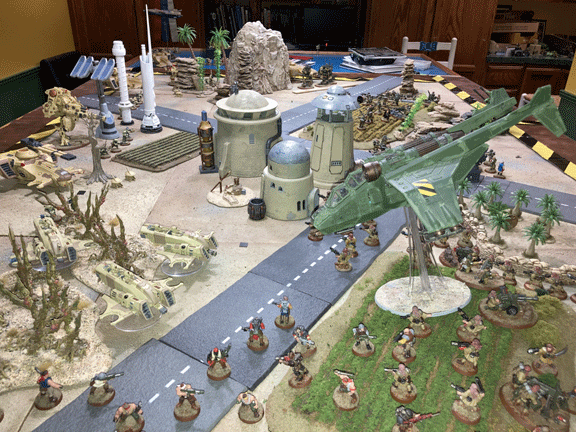
To slow the Imperial advance, and allow Tau heavy weapons systems to target the “human wave” attack, the xenos ordered Piranha skimmers to charge the Tallarn troops.
Tau adapt quickly
By 09:30, regimental commanders recognized a shift in xeno tactics. Enemy armor began to focus on heavy-weapons teams with high explosives, while walkers and Fire Warriors on the front line poured massive amounts of fire on Imperial vanguard in a bid to halt its advance.
The enemy also sent forward small skimmers [Classification: Piranhas] to conduct hit-and-run attacks on lead Imperial formations to force guardsmen to halt and deal with this new threat, thus giving support units such as armor and walkers more time to drop heavy ordinance on these halted Imperial formations.
By 10:00, nearly a quarter of the leading battalions in the Imperial advance were reporting casualties of 25 percent or more. This was a disturbing casualty rate, but Vance had anticipated this problem by tripling the number of commissars attached to these units, and the commissars’ rallying cries (and the threat of their unholstered bolt pistols) ensured that the guardsmen did not falter.
A small Tau village stood in the middle of the battlefield, but the Tau inexplicably did not fortify it. As a result, the advancing battalions largely ignored and bypassed it, but the town’s presence led to the Imperial advance splitting into two isolated columns. This separation, and the lack of mutual support, would have implications later in the day.
Click hear to read Part 2 of this battle report.
—
The Corvus Cluster is a Warhammer 40K blog documenting our gaming adventures in the fantastical sci-fi universe of Games Workshop.
Categories: Damocles Campaign


 THE CORVUS CLUSTER