

The fighting to the southeast of Susa City is taking place in some of the most rugged terrain on the moon of Hegira, and ork casualties are horrendous. Yet Imperial manpower is limited, and the xenos are making progress.
“Damned xenos. The orks have always attacked Susa City from the desert to the west. But some stupid greenskin warlord has decided to advance through the mountains and rough terrain of the southeast. It’s stupid militarily. But, with our troops stretched thin in the fortifications, this line of attack might actually work, this stupidity actually could end being brilliant.“—General Tiberius Vectrix, supreme commander, Hegira Planetary Defense Force
* * *
What follows is a report summarizing the ongoing campaign against the ork assault up the South Cascades region of the Denali Mountains, southeast of Susa City, Hegira:
Recorded: HEGIRA PLANETARY DEFENSE FORCE (PDF): EST 03/750
K’NASH BUNKER – PDF SUPREME HQ 2i3/202.12
INPUT DATE: 3 054 745.M41
INPUT CLEARANCE: Senior officiers
ANALYST: Major Vernetta Cunnane
TRANSMITTED: K’Nash Bunker, Hegira, Regimental Intelligence Service, Q-3
Introduction
More than a year ago, on 3 931 743.M41, a warband of 30,000 orks entered the southern end of South Cascades, a region of cliffs, chasms, and other tortured terrain that Imperial strategists had assumed was impossible for the orks to use as a line of attack against the besieged Susa City.
 The orks did not advance immediately northward but began to build two large settlements that strategists worried were supply depots designed to support a future advance. Imperial bombers were dispatched to bomb the facilities, but they were met with intense anti-air fire, and after losing 20 aircraft in one bombing mission, it was decided that the loss of aerial assets was too costly and future missions cancelled.
In an impressive act of foresight, General Tiberius Vectrix had ordered in 741.M41 the hasty construction of a ring of Imperial Bastions on the outskirts of Susa City. The 12th and 13th Engineering Battalions were assigned to fortification building in the South Cascades.
In desert regions, Imperial Bastions were built 500 meters to 2 kilometers outside the city, as artillery in the city could provide considerable fire support. It was determined that the unique terrain of the South Cascades required a different approach.

Ork forces are advancing in two columns through rugged territory, so rugged that even the aggressive greenskins are being forced to limit their attacks due to shortages of reinforcements, food, ammo, and the heavy weapons needed to break through Imperial fortifications.
Construction
The positioning of bastions was decided by Col. Maximillian Orton of the 12th Engineering Battalion. He argued that the terrain was so rugged, the orks would face an impossible logistical problem unless they advanced up a handful of difficult footpaths, and if Bastions were built there, the greenskin’s lust for battle would actually allow Imperial forces to guide the orks where tacticians wanted.
Construction began in early 742.M41, and five Bastions were completed by mid-743.M41. A sixth Bastion was abandoned half-built, as small ork warbands began to enter the region and high command didn’t want to provoke a xeno response by trying the defend the construction.
Those Bastions completed incorporate the traditional ferrocrete bunker but are enhanced with a ring of trenches, tangle wire, and fortified weapons platforms 200 meters behind the outer perimeter. The fortified position is defended by a battalion-sized force.
First wave of attacks

The Imperial Bastion, boasting 30-centimeter-thick ferrocrete walls, are built to withstand orbital bombardments, so they are a cornerstone of the defenses surrounding Susa City—particularly in the South Cascades region.
Bastion 18 was the first position to draw the attention of the orks. On 3 491 744.M41, a force of approximately 200 greenskins appeared on a ridge in front of the position and opened fire with light arms.
Half the force charged the bastion and were easily killed before they came within 300 meters of the perimeter, but it is surmised that this hopeless attack was designed to reveal the firepower of the position. (Ork warlords can be cunning.)
Three weeks later, more than 10,000 orks marched on Bastion 18. Instead of attacking, they began an artillery bombardment that lasted 12 hours, destroying one trench, damaging two more, and tearing apart the perimeter’s ring of tangle wire.
An ork attack soon followed. The greenskin infantry was joined by a score of Deff Dreads and Killer Kans. The fighting was intense, with Imperial firepower mowing down the orks, who were not intimidated by their losses. In the end, the orks were repulsed, but the Bastion suffered 100 casualties.
At this point, the fight for Bastion 18 turned into a siege. Ork artillery would be silent for weeks, then a new barrage would begin, followed by another assault.

The South Cascades is rugged terrain, featuring chasms, cliffs, sheer walls, and narrow passes. That the orks are advancing on this front strikes Imperial generals as madness. Yet, Imperial lines are spread so thin that a new front in the siege of Susa City is a serious threat.
Successful strategy
Th first attack on Bastion 19 some weeks later was remarkably similar to the assault of Bunker 18. There was an initial all-out assault, and then the fighting turned into a siege.
The orks’ behavior mirrored almost exactly with the predictions of Col. Orton. The orks would run out of ammunition after their first assault, then spend weeks bringing up more ammunition and warriors through the rugged passes, and then make another assault.
Ork casualties mounted, with both fortifications surrounded for hundreds of meters with a carpet of greenskin corpses. Indeed, soldiers were forced to wear respirators outdoors, as the rotting corpses released a cloud of spores that blanketed the surrounding countryside and left unprotected soldiers with severe respiratory problems.
But Col. Orton’s strategic sense worked. Although small parties of orks bypassed the Bastions in search of a fight, the vast majority were drawn to the fighting at the Bastions. The fortifications held for months, although Imperial casualties gradually and fatally weakened their defenses.
Loss of two strongholds

The Tarantula Sentry Gun is a key element in the defense of the South Cascades. It is particularly useful when positioned at the end of a ravine or footpath surrounded by rough terrain Enemy units can be pinned down, yet the autonomous gun is relatively safe from flanking operations.
On 3 789 744.M41, Bastion 18 fell. By this date, there were only 100 soldiers in the garrison able to carry arms, and they had long since retreated inside the Bastion walls. The fact that the orks did not attack in the prior month unnerved the defenders, and with good reason.
When the final ork assault came, it was massive. Every xeno artillery piece targeted the Bastion itself, and when the bombardment ended, thousands of orks rushed the fortification. Although many xenos were killed in their charge, there simply wasn’t enough Imperial firepower to stop them. When they reached the Bastion walls, they began setting explosive charges, sometimes setting them off without withdrawing to a safe distance.
According to the last vox report broadcast, even these explosives didn’t penetrate the Bastion walls—but they did weaken them. The end came when a Deff Dread used a Power Klaw to hammer at a weak point in the walls and, once penetrated, orks poured into the Bastion and slaughtered its garrison.
A similar attack led to Bastion 19’s fall two weeks later.
Current situation
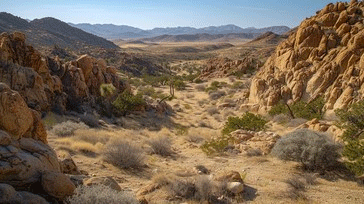
For the Imperials, one advantage of the South Cascades is that orks must advance on foot up narrow ravines that limit their maneuver. The terrain is impassible to vehicles, with the exception of walkers.
It was two months before the orks advanced on the next line of Bastions. Aerial reconnaissance reports that the ork supply lines are so long that nearly half of the greenskins are carrying supplies and, when an attack is launched, the orks simply drop their supplies where they stand and rush to the fighting.
The result is a logistical nightmare, as it takes a month of “head bashing,” as ork leaders refer to it, to prod ork warriors into carrying the supplies needed to launch a new attack. These attacks, which were two or three weeks apart with the most southern Bastions, are limited to every six to eight weeks with the new defensive line.
Bastion 23 has fought off three major attacks and five minor ones and, although the garrison has fallen back to its inner perimeter, a reinforcement of men by Valkyries has kept the garrison at half strength.
Bastion 21 has been the target of long-range artillery fire, but the ork warband advancing on it numbers only about 5,000 and is not considered an immediate threat. However, there is an ever-increasing number of orks marching along the footpaths that lead to the fortification. It will not be long before it also finds itself besieged.
To delay this eventuality, fighter and bomber aircraft are regularly attacking the footpaths to kill, or at least delay, the ork advance.
Conclusion
The unanimous opinion of headquarter strategists is that the greatest threat to Susa City will come from the western desert, where it is easiest for the orks to gather a massive assault force and quickly reach the walls of the city .
For this reason, we recommend that Bastion 21 and 23 be brought up to full garrison strength through the use of air transport—before sufficient enemy artillery and heavy weapons are available to make aerial reinforcement impossible.
We also recommend the assignment of additional commissars to the garrison. Troop morale is low, as the fall of our southern bastions makes clear that assignment to these bastions is likely a suicide mission.
If these steps are taken, we believe that Bastion 23 can hold out for another three to six months, and Bastion 21 could last as long as a year.
Meanwhile, Bastion 22—our last line of defense before the city’s outer walls—should be expanded and reinforced. The likelihood of an all-out assault on Susa City’s eastern defenses—similar in scale to the massive attack of 740.M41—is very likely in the next year. If we repel this assault, we should have a lull in fighting, and we could transfer men from the walls and significant reinforce against this threat in the South Cascades.
+ + END REPORT + +
Click here for more great artwork by Carl Holden.
—
The Corvus Cluster is a Warhammer 40K blog documenting our gaming adventures in the fantastical sci-fi universe of Games Workshop.
Categories: Hegira Campaign


 THE CORVUS CLUSTER