
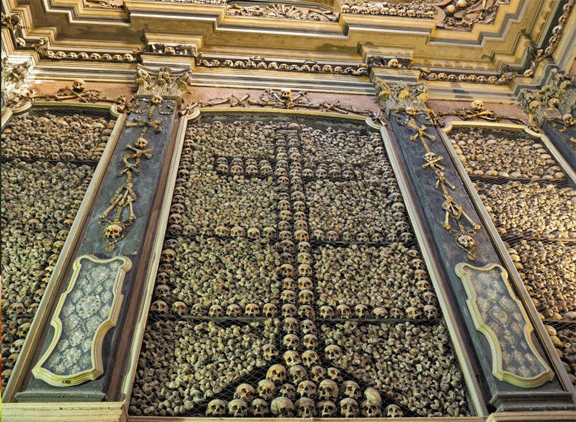
In honor of the Emperor’s sacrifice for humanity, the monastery does not bury its deceased monks and servants. In a millennia-long tradition, the corpses of acolytes are boiled to strip the bones clean, and the skulls used to decorate the monastery’s walls, pillars, and ceilings.
HEGIRA—After orks were repulsed in their recent advance on the Monastery of the Emperor’s Light, it seems appropriate for our illustrious guardsmen to know more about the monastery where they may be asked to make the ultimate sacrifice in its defense.
The monastery was founded in 474.M36 by a missionary named Emiliot Drasus, who would later become Saint Drasus the Sanctified after his exploits during the Four Heresies Campaign of 493-96.M36.
Drasus sought the most isolated and hostile environment for his new mission, as he felt that, to truly understand the Emperor’s will, a follower of the Imperial Creed must meditate without interruption.
Although Drusus eventually left the monastery to join an Imperial Crusade, his disciples devoted themselves to creating a religious settlement that embraced isolation and meditation.
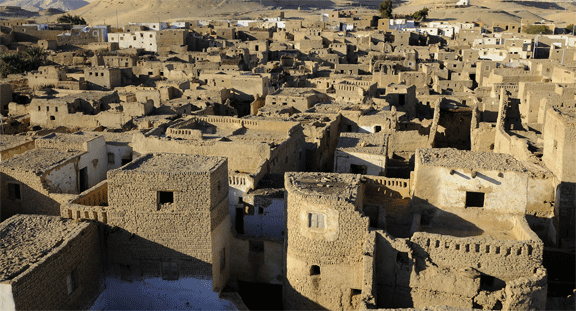
The monastery is a maze of winding paths linking small chambers built over thousands of years. Devotion and sacrifice, not the gaudy edifices favored by the majority of the Ecclesiarchy , are valued by this sect of the Lethean Revelation.
Religious Beliefs
Little is known about the early practices of the monastery, but it is widely believed it followed contemporary elements of the Imperial Creed.
The turmoil of the Age of Apostasy (M36) largely bypassed the Corvus Cluster, and the political machinations of the Ecclesiarchy totally ignored the monastery. But the heresy had its impact on the monastery’s priests, and in the decades that followed, they increasingly embraced the teachings of a sanctioned yet radical sect known as the Lethean Revelation.
Their interpretation of the Imperial Creed is “that either humanity is born damned and that redemption can only be achieved through divine suffering in the God-Emperor’s name, or that redemption is impossible and only holy torment exists.” ¹
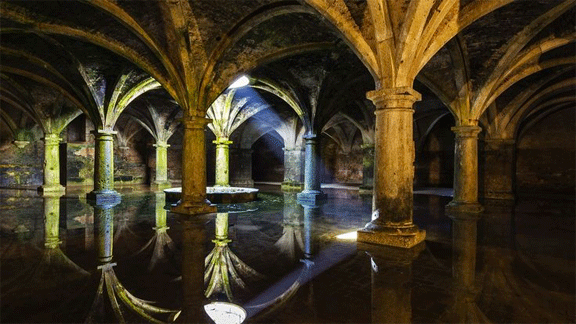
Underground cisterns cool the surrounding air. As warmer air rises within monastery buildings, this cool air is pulled upward through vents and provides a low-technology air-cooling system.
This pessimistic viewpoint has led many adherents to practice self-flagellation and abject obedience, preach that “the Emperor condemns,” and that any suffering should be embraced and celebrated as a holy gift.” ²
The monastic ranks view flagellation as an opportunity to share in the sufferings of the God-Emperor, and some monks over the centuries have reported holy visions from the ruler of humanity. In some instances, this has led priests to abandon the monastic life to join Imperial Crusades and seek divine suffering on the battlefield.
The monastery discourages visitors, but those who have visited on Imperial business report that most acolytes avoid interaction with outsiders whenever possible. There also is, it’s said, a marked atmosphere of gloom, antipathy, and stoicism.
“None fall as far or as fatally as those who soar the highest, for pride does not precede the fall. Pride is the fall.”— The Lethean Revelation – Psalm 451

One of many “wind catchers” that cool the monastery. As desert winds enter the structure, the air is deflected into the rooms below, displacing warmer air that exits through the large vertical slots.
Unusual Architecture
The monastery was not built, as most, into a massive gothic edifice that glorifies the Emperor—but instead was built, by hand by the priests themselves, as a collection of modest buildings. Over the centuries, as more buildings were added, the monastery took on the appearance of a village—with narrow walkways that created a randomly designed, winding maze.
Also unique to the monastery is the priest’s limited use of technology. The sect eschews the use of cherrubs or servitors, preferring manual labor in all things.

While the fountain cools the air at the bottom of the chamber, holes in the ceiling allow warmer air to rise and exit the space.
The architecture reflects this anti-technology zeal, highlighted by a surprisingly low-tech but well engineered system of cooling the monastery from the desert heat. Among its features:
• the use of thick stone and hand-made ceramic tiles that do not absorb heat as readily as most Imperial building materials,
• passive cooling systems, such as open-air courtyards, vented domes, and stone cooling towers that draw surrounding heat upward and out of buildings,
• narrow streets and walkways, often filled with vegetation, designed to limit sun exposure,
• aqueducts built underground to cool air that is allowed to rise into buildings through vents, and
• fountains and clay pots filled with water that use the water’s evaporation to cool a room.

The danger to the monastery has grown exponentially as ork forces advance closer.
Current Threat
Located on Hegira, the fate of the monastery will be determined by the deteriorating military situation on the desert moon.
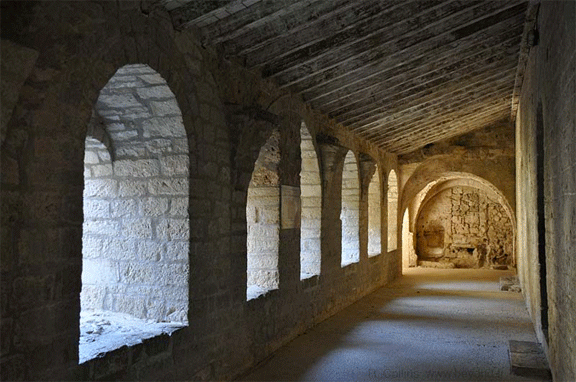
With the exception of a few important shrines, the monastery’ is notable for its simple and austere architecture.
A decade-long war against ork invaders has left Imperial forces in control of only 20 percent of the moon’s surface and, although much of the orks’ attention focuses on the besieged capital of Susa City and a low-grade civil war amongst the greenskins, there are an increasing number of attacks targeted Imperial forces in the Sea of Dust region.
In fact, the monastery is only a few hundred kilometers north of the current fighting. Given the landscape is barren, and the Imperial entrenchments somewhat porous given the volume of space that must be defended, a major attack by the orks could put the monastery in the middle of a major battle.
Military authorities have warned that, while they intend to defend the monastery if possible, they cannot guarantee the safety of the monastery or its inhabitants.
Abbot Ultan Sillan has stated that the monastery is a fortified position, and its monks and priests are trained in military tactics. In recent years, the monastery also has enlisted a host of new initiates into its ranks, and they have received “significant training.”
“I have no intentions of fleeing a holy site of the God-Emperor,” he has announced. “He shall see us prevail against the xeno filth, or we will lose and suffer in His name.”
—
The Corvus Cluster is a Warhammer 40K blog documenting our hobby adventures in the fantastical sci-fi universe of Games Workshop.
Categories: Notable Landmarks


 THE CORVUS CLUSTER