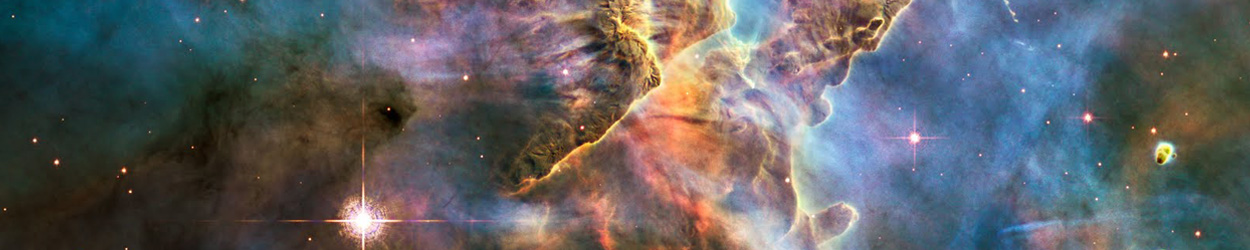

The dominating feature of the Sculptor System is its seven gas giants. Yet, perhaps more notable, is the presence of two dozen habitable moons orbiting these planets, with many of these worlds inhabited and some clearly terraformed in the distant past.
These moons run the gamut of Imperial classifications: hive worlds, industrial worlds, civilized worlds, mining worlds, and more. Almost every moon, even those classified as dead worlds, have some human presence upon them.

Of particular note to the Adeptus Mechanicus is the presence of Terra-sized rocky moons in the outer region of the system. Across the universe, moons of a system’s outer planets are commonly small and essentially frozen ice balls.
The number of rocky planets on the system’s outskirts almost certainly indicates not just the use of Terraforming but of an astonishingly powerful mechanism for moving planet-sized objects—an advanced engineering technique from the Dark Age of Technology and long since lost.
What follows is only a partial list of the system’s more interesting locales. Some notable moons—Belzagor, Dar Sai, and Hegira—are absent from this list, as ongoing xeno invasions already have made these world familiar to Imperial citizens.
BIFROST — ICE WORLD
The fifth planet of Sculptor V has one of the most wondrous horizons in the galaxy: the purple majesty of Tyrian, the second largest gas giant with spectacular planetary rings, dominates the sky.
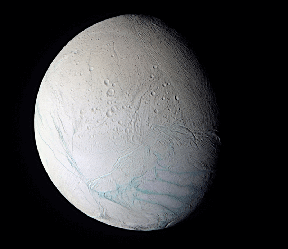
Despite freezing temperatures and a barren snowscape, Bifrost does not quite meet the definition of a Death World. Although fast-moving storms develop, the thin atmosphere mitigates any damage by high-velocity winds, and temperatures rarely drop below -20º C.
The 20 million inhabitants of the moon are largely employed in harvester-colonies that collect nutrient-rich fungus that grows in underground hot springs ubiquitous to the moon.
COLSITI — SPOIL WORLD
The second moon of Sculptor IV, this Terran-sized moon is widely believed to have been the first to be colonized untold millennia ago.
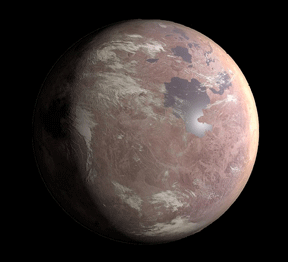
These millennia have not been kind to the world. It has been ecologically raped: its mineral deposits exploited, its surface ravaged by huge slag piles that leach toxins into the water supply, its atmosphere poisoned by air pollution from old mining extraction factories, and much of its original flora and fauna long since driven to extinction.
In fact, by the 41th Millennium, the biosphere of Colsiti has collapsed entirely. Although colonies of algae and nests of vermin eke out an existence, much of the world is barren and devoid of life.
The human population—greatly reduced from better days—is limited to half-empty and decrepid hive cities, as well as semi-barbaric and nomadic tribes that hunt for scrap metal, abandoned technology, and other valuable detritus in long-abandoned mining assemblies and manufactorums.
DECORA MINING BASE — ARTIFICIAL HABITAT
The Decora Mining Base is a massive space station—essentially a floating city—that is located in the Great Asteroid Belt between the gas giants of Sculptor IV and V.
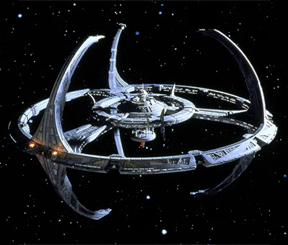
An ancient relic, found abandoned when the Great Crusade arrived in the latter years of M30, the 8-kilometer-in-diameter space station slowly was re-inhabited by various space-faring mining guilds that search the asteroid field for rare minerals.
It’s population has varied from between 50,000 to 100,000.
Until a few years ago, the mining base—ruled by a 12-member council of guild leaders—was a thriving hub of ore refining and trade. But, in 738.M41, a Tau naval force assaulted the station and took control.
Mining operations were allowed to continue, but the Tau kept miners’ families as hostages to force miners to sell their ore to the xenos at a fixed price.
Five years later, a contingent of the Knights of Altair Space Marine Chapter boarded the station and, after days of fighting, cleansed the base of its xeno taint.
Guild leaders were executed for collaboration with the xenos, and a strict re-education program was imposed on the station’s surviving population. A new ruling council, chosen from the Administratum and Adeptus Arbites, now watch the mining guilds with a strict eye to Imperial compliance.
MORTHRAI — CIVILIZED WORLD
Morthrai, the second moon of Sculptor II, is an financially affluent agri-moon with a population of 400 million. The wineries of the planet are said to produce the finest red wines in the entire Corvus Cluster.
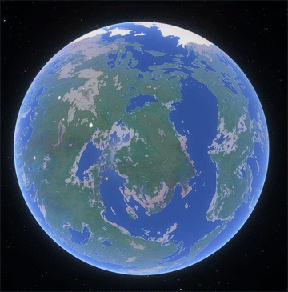
Similar to nearby Dar Sai, the government is feudal , and most of the moon’s surface is owned by an aristocracy.
Unlike Dar Sai, however, the noble families do not oppress their workforce. Instead, they lease agricultural land to the workers and encourage them to work hard by granting them a a sizable share of the profits of their hard work.
As a result, the agricultural workers of the moon are relatively affluent, and given they are aware of the oppression of workers on Dar Sai, there is a degree of political stability on Morthrai that neighboring moons envy.
Indeed, while this policy has long been a sore point for Dar Sai’s oppressive aristocracy, the gentler government style on Morthrai has greatly aided its aristocracy in stymieing Tau efforts to spark rebellion among the workers and bring the moon under xeno influence.
If anything, The Tau have learned that sending members of the Water Caste to promote rebellion against Imperial rule on Morthrai usually leads to a quick death to the xenos as even the lowliest workers will turn them in to authorities for a financial reward.
PUSUANOPE — MINING WORLD
The closest moon of Sculptor II is a mining world with a troubled history of governance. In the 28th Millennium, the planetary Governor, Raphael Qvann, attempted to raise the price of ore shipments to other worlds in the system. That provoked these worlds to combine their Planetary Defense Forces to invade Pusuanope.
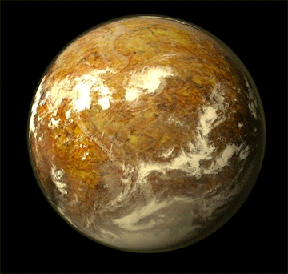
What followed was a six-year, in-system war that ended only with the arrival of the entire Knights of Altair Space Marine Chapter and six Imperial Guard regiments, which removed Qvann from power and, under the eye of the Administratum, installed a new governing council to rule.
Over the centuries, however, corruption has taken hold, and today the planetary elite rule with an iron hand, viewing the populace as little more than slaves—working them under harsh conditions and keeping them in line with the threat of brutal reprisals.
THUGON — DEAD WORLD
The fifth world of Sculptor VII is an ice-covered, rocky planet that’s twice the diameter of Terra and has a gravity field four times as strong.
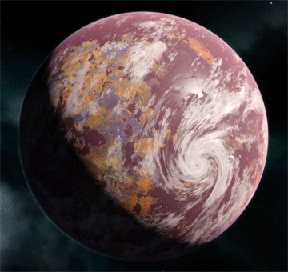
The planet has a population of 12 billion, however, because the moon is rich in adamantium and ceramite deposits, extremely rare and valuable ores that have made it economically viable to build mining factorums over key deposits.
Life is brutally short on Warmok. Although gravity-inhibitors are widely used to ease negate the moon’s high gravity, the ruling government does not believe it is cost-effective to reduce the gravity to Terra normal.
As a result, miners—consisting of convicted prisoners and poorly paid indigenous menials—work long hours in dangerous conditions, and the above-average gravity (2 G) greatly stresses their bodies, ensuring a life expectancy on average of 40 years.
WARMOK — VOLCANIC WORLD
As the closest satellite of Sculptor III, Warmok’s molten core is stretched and twisted by tidal forces, resulting in immense geological activity.
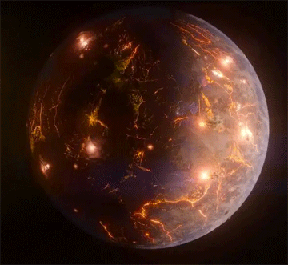
In addition to frequent quakes, the surface is covered with active volcanoes that erupt and release sizable quantities of ash into the atmosphere and cover the landscape with flows of lava.
High surface temperatures and a toxic atmosphere, in addition to seismic activity, makes any habitation challenging at best. Yet, a small Adeptus Mechanicus facility is known to operate in a mountain range near the moon’s equator.
The purpose of the facility has never been explained by the Mechanicus and inquiries have been politely rebuffed.
—
TheGM: Every once in a while, I like to flesh out some corner of the Corvus Cluster. The other day, I was wondering what some of the other moons in the Sculptor System were like–so I decided to flesh them out.
It was hardly necessary to write something for all 32 moons. As does Games Workshop, I like to keep some things with a clean slate, so I have some options in the future.
But writing something on these moons planets serves another purpose. Now I have some new settings to ponder: I’m painting up a small Valhallan platoon and ordered an “ice world” terrain mat. Could something happen on Bifrost that gives me an opportunity to put my new hobby goodies to use?
And what would it be like to fight on a volcanic world? Hmmm . . . .
—
The Corvus Cluster is a Warhammer 40K blog documenting our gaming adventures in the fantastical sci-fi universe of Games Workshop.
Categories: Worlds


 THE CORVUS CLUSTER
I often read your posts via the email but don’t get to your blog to comment. Comments help fuel productivity! This was a cool writeup, not a few of these planets I though: that would be fun to game on (rpg/wargame/whatever).
LikeLike
Thanks for sharing!–TheGM
LikeLike